

Developer preview
Turn RAG traffic into
retrieval intelligence.
Your query stream is the missing dataset. Pelorus Query turns repeated user and agent questions into curated Extracts, clusters, coverage signals, and corpus gaps you can inspect and act on.
It helps you see what people are trying to learn, where your corpus supports them, where it falls short, and which high-value answers deserve human-curated, source-grounded Extracts.
THE PROBLEM
RAG systems answer queries, then forget what the queries were trying to tell them.
Query logs are usually treated as exhaust: useful for debugging, maybe evaluation, but not part of the retrieval layer itself. That leaves the most valuable signal outside the system: what users and agents repeatedly need from the corpus.
Pelorus Query preserves that signal as durable queries, then uses it to reveal demand, overlap, partial coverage, and true corpus gaps. The point is not only to improve a match. It is to understand where the knowledge surface needs curation, new source material, or a broader reusable answer.
THE SHIFT
Move from optimizing matching to understanding demand.
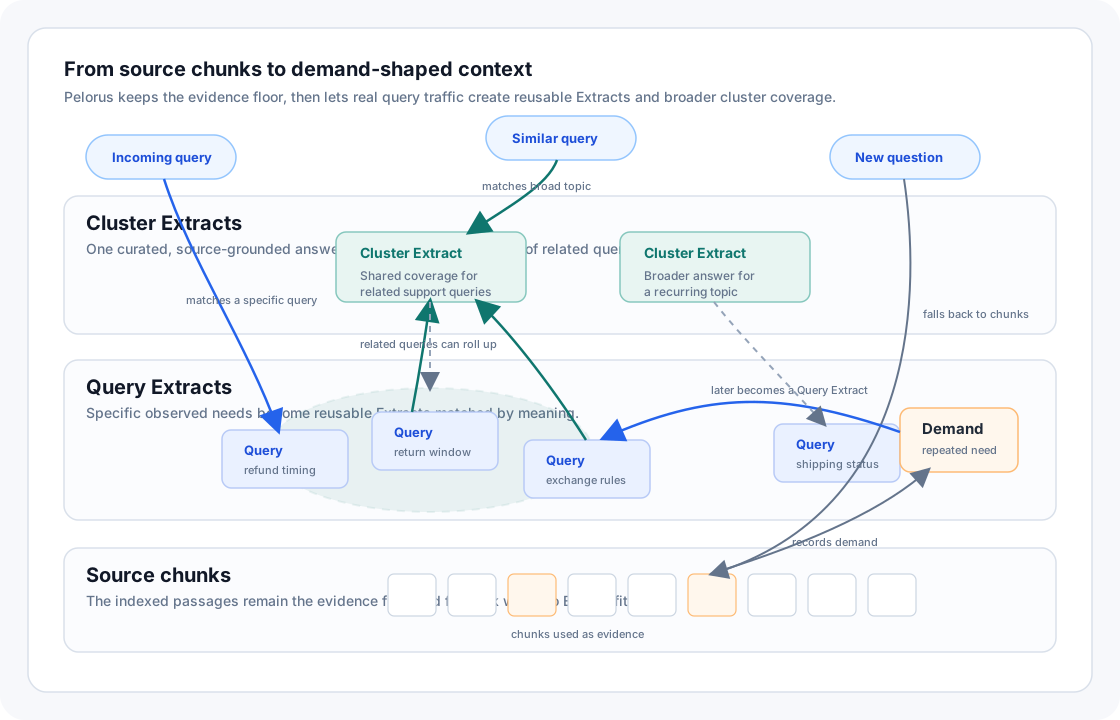
Most retrieval work starts with the supply side: documents, chunks, embeddings, rerankers, and prompt context. Pelorus adds the demand side: the actual questions flowing through the system and the patterns they form over time.
Embeddings become a lens, not just a lookup.
The same vector space can compare queries, queries, chunks, and clusters
so you can see where traffic concentrates, which needs share evidence,
where clusters overlap, and where the corpus has no adequate answer.
That creates an operating loop.
Observe demand, identify gaps, create or refine source-grounded Extracts,
and curate the knowledge surface as traffic changes. Human curation is
focused where the evidence shows it matters.
WHAT IT DOES
Pelorus Query
Demand intelligence for source-grounded retrieval.
Pelorus Query watches live RAG traffic, turns recurring needs into durable queries, maps emerging clusters and gaps, and lets operators curate source-grounded Extracts where the query evidence shows they will matter.
Query memory
Repeated questions become durable queries with hit counts, vectors, examples, and retrieval outcomes. The system can learn what demand exists instead of treating every query as isolated.
Demand maps and gaps
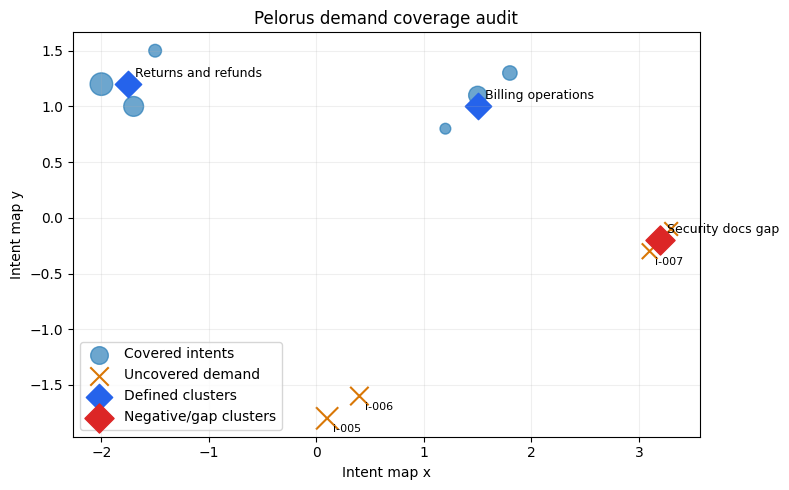
Visualize where traffic concentrates, where related needs form neighborhoods, where answers overlap, and where the corpus falls short or needs new source material.
Curated Extracts
Turn high-value demand into source-grounded Extracts that carry the context needed to answer. Subject-matter experts can refine them without rewriting the original documents.
Adaptive retrieval surfaces
Future queries can match learned queries and cluster-level Extracts, not only raw chunks. Retrieval adapts from observed demand while remaining grounded in the corpus.
ACTIONABLE INSIGHTS
What you can decide from the demand map.
Create or refine an Extract when a recurring query is supported by source material but still falling back to chunks. That is a curation opportunity, not just a retrieval miss.
Add or repair source material when demand has no adequate supporting chunks. Pelorus makes corpus gaps visible so the fix can be content work, not endless threshold tuning.
Split, merge, or overlap clusters when traffic shows messy boundaries. The goal is not perfect clustering; it is a retrieval surface that reflects how people actually ask.
HOW IT'S DIFFERENT
Where chunking and matching still fit.
Pelorus does not compete with your chunking.
Contextual retrieval, parent-document and hierarchical retrieval, agentic chunking,
and reranking all improve the chunk representation at ingest, before any
traffic arrives. They make the upfront bet better; they don't remove it.
Pelorus Query sits on top of that work, not in place of it.
It keeps your chunk retrieval as the grounded floor and adds a second layer shaped by
live demand: recurring queries become curated Extracts you can refine, correct, and
fill gaps in — without re-chunking, re-embedding, or re-ingesting the corpus.
Built to sit on your own pipeline.
Pelorus Query competes on what happens after the match — curation,
coverage, and reuse — not on how you split documents. Your chunking, embedding,
and vector store stay yours, behind a read-only
RAG Connector interface.
In this developer preview Pelorus runs its own bundled stack behind that
interface — you can write and validate a connector against the contract
today, but selecting your own is the next step on the roadmap, not a switch you can
flip yet.
Status
Open-source developer preview.
Pelorus Query is early software for builders exploring retrieval observability, demand-driven curation, and source-grounded evidence workflows.